RAG for Structured Data: Benefits, Challenges & Examples

As many sectors adopt AI agents and integrate AI-driven processes, it is increasingly important to ensure confidence in the systems being deployed.
However, challenges arise when internal data spans thousands of tables, hundreds of attributes, and extensive knowledge bases containing structured yet difficult-to-navigate information.
Retrieval-augmented generation (RAG) can address this. RAG grounds a large language model’s (LLM’s) output in enterprise data by retrieving relevant records or content from knowledge repositories, significantly reducing inaccurate or irrelevant outputs.
This distinction is critical because traditional large language models have known limitations. They may lack current or domain-specific context and can generate inaccurate content. For example, an OpenAI technical report found that the o4-mini model generated accurate summaries of publicly available information only 48% of the time.
This article examines the distinctions between applying RAG to structured and unstructured data, and outlines considerations for enterprises building a RAG-based extraction workflow.
What is Retrieval-augmented generation (RAG)?
Retrieval-augmented generation (RAG) combines a large language model (LLM) with external data sources to improve factual accuracy and domain relevance.
Rather than relying solely on the LLM’s pretrained knowledge, RAG pipelines retrieve information from external sources — such as databases, documents, or enterprise knowledge bases — to augment model outputs.
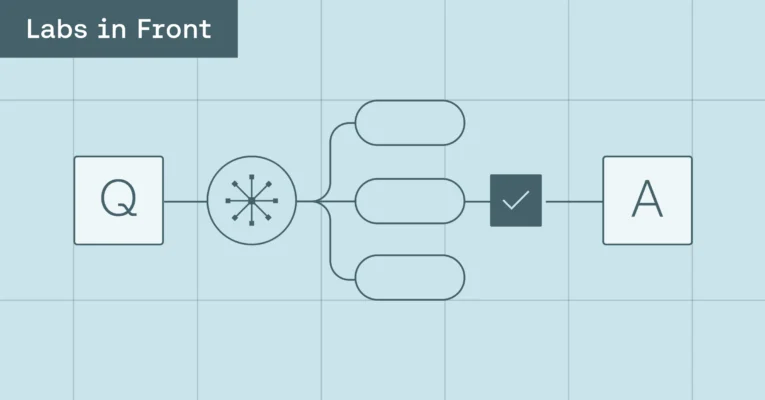
A standard RAG workflow first processes the user query and retrieves relevant information using techniques such as vector search – which identifies semantically similar text using vector representations – or structured database queries.
The retrieved content (e.g., text passages or records) is then provided to the LLM along with the original query, enabling it to generate a contextually grounded response. This two-step process — retrieval followed by generation — ensures outputs are both coherent and anchored in source data.
For enterprise use cases, RAG enables LLMs to incorporate internal content such as knowledge bases, financial statements, patient records, or technical documentation without model retraining. This supports deployment of domain-specific applications with improved accuracy and operational efficiency.
What are the different types of RAG data?
Retrieval-augmented generation (RAG) systems can utilize both structured and unstructured data sources to ground a large language model’s (LLM’s) outputs in enterprise context.
Unstructured data includes free-form text, such as documents or PDFs, while structured data refers to organized formats such as relational tables or knowledge graphs.
| Data Type | Description | Examples | RAG Usage |
| Structured Data | Organized data with a fixed schema (e.g., rows and columns). | Relational databases, spreadsheets, knowledge graphs | Translates natural language into structured queries (e.g., SQL) to retrieve precise, verifiable answers. |
| Unstructured Data | Free-form text without a predefined structure. | Documents, PDFs, articles, emails, web pages | Uses vector search to find semantically relevant text segments for grounding responses. |
| Semi-structured Data | Partially organized data using key-value pairs or tags. | JSON, XML, NoSQL databases, API outputs, logs | Parsed and searched programmatically; supports flexible yet meaningful grounding in RAG systems. |
Structured data
Structured data is highly organized and formatted, making it easily searchable. Examples include relational database tables, spreadsheets, and knowledge graphs.
In a RAG context, structured data use typically involves translating a natural language query into a structured query (e.g., SQL) that returns specific records. The LLM then uses those records — or their aggregated results — to generate a response.
Because the data has a consistent schema (e.g., rows and columns with defined types), RAG implementations using structured data can produce precise, verifiable answers — for example, “total clients acquired in Q1 2024” — directly from enterprise databases.
Unstructured data
Unstructured data includes text-centric content lacking a predefined schema, such as documents, articles, PDFs, emails, or web pages. In RAG applications, unstructured data retrieval typically involves vector search or other information retrieval techniques.
Text is segmented into smaller units, converted into vector representations (mathematical formats that encode meaning as numerical values), and then searched for passages relevant to the query.

Semi-structured data
Semi-structured data — such as JSON files, XML documents, NoSQL databases, APIs, logs, or system integration formats — contains partial structure through key-value pairs (e.g., “name”: “Edward Smith”). While not strictly organized like relational data, it still supports programmatic access and may be leveraged in RAG pipelines with appropriate preprocessing.
What are the benefits of using RAG with structured data?
Retrieval-augmented generation (RAG) models use external knowledge sources to retrieve relevant, up-to-date information before generating a response. Structured data offers specific advantages in enterprise environments, particularly where accuracy, consistency, and data governance are critical.
Factual accuracy
By retrieving answers directly from verified enterprise systems — such as databases or knowledge graphs — RAG applied to structured data produces outputs grounded in authoritative sources. This significantly reduces hallucination, as the large language model (LLM) retrieves the actual value or policy detail from structured data rather than generating content based solely on its training data.
Semantic precision
Structured data supports semantic precision by enabling the system to interpret and align with the underlying schema. For instance, if a query involves “legal cases in Q1 2024,” the system can resolve this to the appropriate table and date range. RAG effectively maps natural language to structured formats, enabling responses that are both contextually and numerically accurate.
Consistency across departments
Centralizing retrieval through a single, trusted data source promotes consistent answers across teams and applications. When all departments rely on RAG to access a shared database, the system standardizes output and avoids discrepancies introduced by individually fine-tuned models or siloed datasets.
Cost efficiency
RAG with structured data reduces the need to retrain LLMs on enterprise-specific content. Instead, data is accessed at runtime, minimizing inference cost and storage requirements. This also improves token efficiency — rather than embedding entire documents, only relevant rows or fields are retrieved and included in the prompt context.
What are the key challenges in working with structured data?
Structured data provides precision and reliability, but it also introduces technical and operational challenges when used with RAG systems.
For a real-world look at how organizations overcome these challenges, read our breakdown of structured RAG and its accuracy gains.

Large schemas and complex queries
Enterprise databases often contain hundreds of tables and thousands of fields. When users submit complex queries spanning multiple tables, it becomes difficult for a large language model (LLM) to identify relevant schema elements — especially if the full schema is included in the prompt. Developers must supply only relevant components.
Further, queries like “legal cases won in the EU vs. America over the last five years” require the LLM to reason across joins, filters, and aggregation logic.
SQL generation errors
RAG systems using text-to-SQL may produce invalid queries — including syntax errors, incorrect table references, or missing filters — especially with complex schemas. Ensuring consistent generation of accurate, efficient SQL often requires validation steps or fallback mechanisms in the pipeline.
Context window limitations
LLMs have a fixed input size (context window), limiting how much schema can be processed at once. Large schemas may exceed this, requiring strategies such as schema filtering, iterative prompting, or semantic search over schema elements to reduce context length.
Domain-specific language
Structured data often includes domain-specific codes, acronyms, or encodings that LLMs cannot interpret without additional context. Supplementing queries with data dictionaries, descriptions, or sample values helps the model generate accurate outputs aligned with domain semantics.
How can a prompt be enhanced by a RAG strategy?
Below is an example of an old prompt and an improved prompt for a legal scenario where the large language model (LLM) is grounded in a corpus of legal texts or a database of legal documents and case law.
| Prompt without RAG | Prompt with RAG |
| “Summarize the key points of the Johnson v. Smith employment discrimination case.” | “You are an assistant for a paralegal. Based on the retrieved documents and real-time data from the Johnson v. Smith employment discrimination case, provide a summary of the key points, including the claims made, legal arguments presented by both sides, and the final ruling. Cite relevant sections from the retrieved case documents to support your summary.” |
The use of RAG enhances prompts by retrieving relevant legal documents or data, grounding LLM outputs in real evidence to deliver accurate, context-specific answers aligned with enterprise knowledge and compliance standards.
How can you build a RAG extraction strategy from structured data?
To effectively use retrieval-augmented generation (RAG) on structured databases, the underlying knowledge must first be extracted and organized into a format that a large language model (LLM) can interpret.
Metadata extraction
Begin by extracting schema metadata from the database. This includes table names, column names, data types, primary keys, foreign keys, and any available descriptions. Metadata provides a structural overview of the database — for example, identifying a table named Customers with columns such as ID, Name, and Date.
Most SQL databases expose this metadata through system tables, such as INFORMATION_SCHEMA views. Once extracted and stored, the metadata enables the RAG system to answer structural queries such as “What information exists on all individuals in the database?” This step effectively creates a knowledge graph of the schema that the LLM can use to interpret user queries in terms of the actual database structure.

Sample data
Schema information alone may be insufficient to convey full data context. The next step is to extract a small set of representative rows from key tables. For example, reviewing a few records from a Cases table may reveal that a Status column contains values such as “FILED” or “COMPLETE,” indicating a categorical state field.
Sample data helps expose data formats (e.g., date patterns, status codes) and value ranges. Typically, three to five representative rows per table are sufficient. Sampling should aim for value diversity; random sampling is often more informative than sequential retrieval.
These examples provide additional grounding at inference time. When answering queries, the system can retrieve not just schema information but also representative values to help the LLM interpret user intent accurately.
Entity relationships
Understanding relationships between entities is essential for resolving multi-table queries. For example, answering “Which clients lost cases in January?” requires knowledge of how Clients and Cases tables are linked.
While some databases define foreign keys explicitly, many real-world databases rely on implicit relationships. These can be inferred through column and table name patterns — for example, a column named ClientID in one table and a table named Clients suggest a join relationship.
Sample data overlaps can also be used to infer strong associations. Inferred links can be converted into natural language statements or structured triples, such as: “Each client is linked to a case file via CaseID.” These descriptors can then be stored in the retrieval index to support accurate grounding during query resolution.
What are the best practices and tips for optimizing data workflows?
When dealing with large structured databases, it is important to optimize what and how you extract so your RAG knowledge base remains manageable. The following tips can help:
- Prioritization: Focus on the most crucial tables and fields first. For instance, if only 20 tables out of 200 are frequently queried in your use case, prioritize those for detailed extraction (metadata, samples, relationships) and include only basic information for the others.
- Case by case: Extremely large tables may be handled specially; you might include their schema but no samples, or just samples of key columns, to avoid overwhelming the system with excessive data.
- Summaries: If you have multiple similar tables (such as partitioned tables or monthly logs), consider grouping them as a single logical entity rather than documenting them individually.
- Keyword indexing: Once you have the extracted knowledge, use a combination of keyword indexing and vector embeddings for semantic search on the content.
- Incremental updates: If the database schema changes or new data patterns emerge, the knowledge base and embeddings can be refreshed without requiring a complete rebuild from scratch.
Lastly, involve human experts in the loop. Automatically inferred relationships or descriptions may not be entirely accurate, so it is recommended to have a data engineer or domain expert review the generated schema documentation. This governance step ensures the LLM is not basing answers on faulty context.
By focusing on relevant data, optimizing extraction, indexing for search, updating continuously, and validating with humans, you can build a robust RAG strategy that scales with your structured data while providing reliable, accurate assistance to users.
|

FAQs
-
No. RAG is a flexible approach that can be applied to both unstructured and structured data, and often a combination of the two. All a RAG system needs is the ability to translate a user question into the right query or lookup for these structured formats.
-
https://open.spotify.com/episode/066XGJ2yldCWOhS3Zx01ds?si=2acfa511fc684326Structured data is typically stored in relational databases such as Oracle, SQL Server, or MySQL, as well as in data warehouses. Structured data can also reside in formats such as CSV files or spreadsheets, and in newer cases, graph databases or JSON-based databases.