AI21 Partners with Gong, Deel and Alice to Post-Train Specialized Models on NVIDIA Nemotron 3.5 Super VL
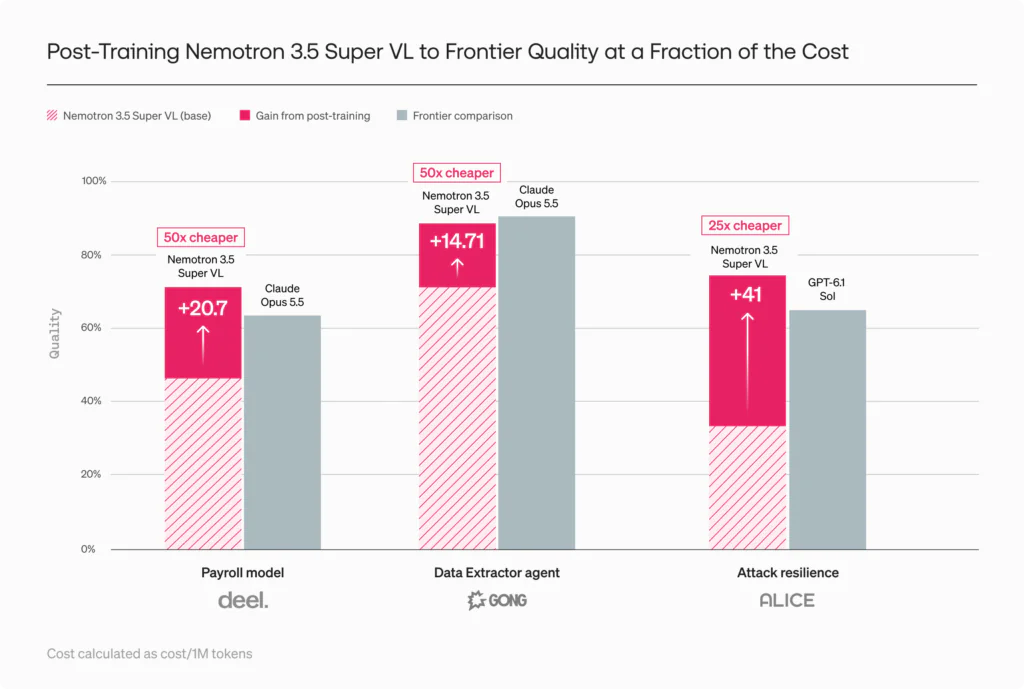
Over the past three weeks, our team of Forward-Deployed Researchers (FDRs) post-trained recently released NVIDIA Nemotron 3.5 Super VL in partnership with Gong, Deel, and Alice to deliver specialized models that surpass or match frontier quality on their defined use case – yet at a fraction of the cost.
As companies increasingly seek to own specialized intelligence, rather than rent general models, AI21’s Lab-as-a-Service offering and proprietary Harness and Model training platform allow companies to make that transition in weeks, not quarters.
The motivation to stop renting, and start owning, intelligence, varies across companies. For some, it’s cost; for others, it’s control over their data or their differential edge. As training partners, our FDRs carefully build post-training recipes and custom evaluations to support customer objectives.
This post dives into the business impact and differentiation enabled by post-training sovereign specialized intelligence, and the methods our FDRs used to get there.
An open foundation for specialized intelligence
NVIDIA Nemotron 3.5 Super VL is an open multimodal model for long-running agents that need to see, reason and act. Engineered for high-accuracy agentic execution, it is designed to be post-trained on an organization’s own data, tools and policies.
Specialized model #1: Matching frontier quality on Gong’s Data Extractor at a fraction of the cost
Post-training objective: Reduce cost without harming quality
Use case summary
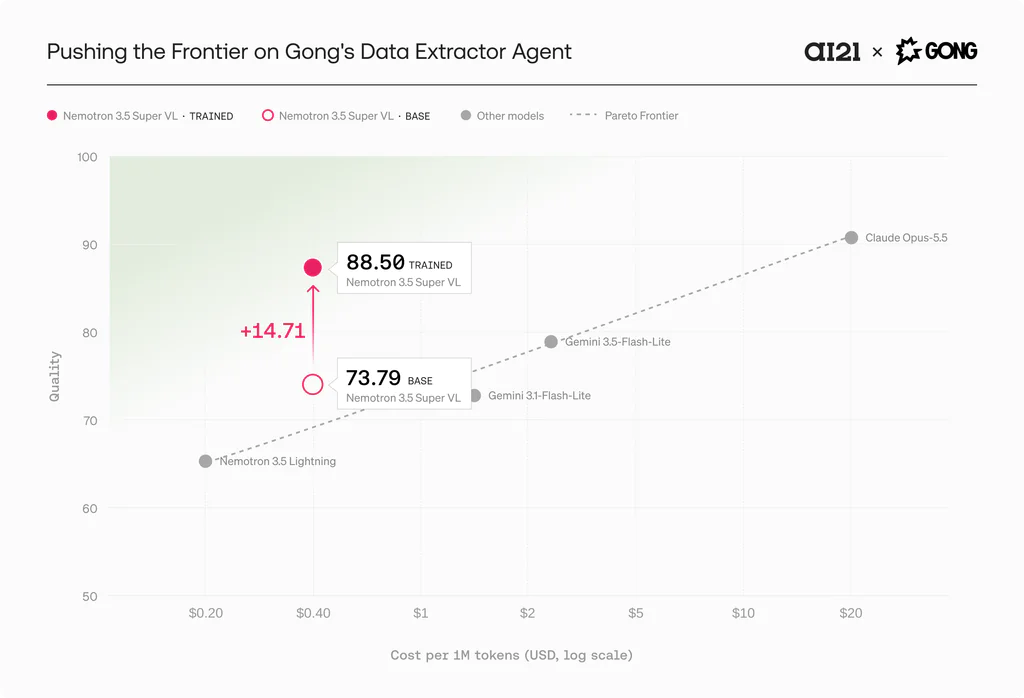
Leading revenue AI company Gong developed an agent, Gong Data Extractor, that reviews customer interactions – such as calls, emails, and web conferences – to identify the key deal and account information vital to revenue teams. It stores these as fields which are automatically updated as new information comes in and can be synced to customer CRM records: everything from deal stage to health scores.
Frontier models summarize deals well. Yet at the scale Gong is working at, processing tens of millions of interactions a month, cost compounds quickly. So far, no cheaper model has been able to match frontier quality on this use case – and sacrificing quality on customer records was non-negotiable.
Methods
The AI21 FDR team collaborated with Gong to post-train Nemotron 3.5 Super to match the quality demanded by such a high-stakes use case, but with all the cost benefits of an efficient, open model. Within just two weeks, the teams built out a unique training dataset, implemented a mixture of SFT and DPO training techniques, and built out the necessary evaluation infrastructure to gate quality on the CRM edits, with extra evaluation layers applied to high-risk metrics.
Results
After post-training NVIDIA’s Nemotron 3.5 Super, Gong’s own evaluations found that the specialized model matches SOTA models like Claude Opus 5.5 in terms of speed and accuracy, and at a small fraction of the cost.
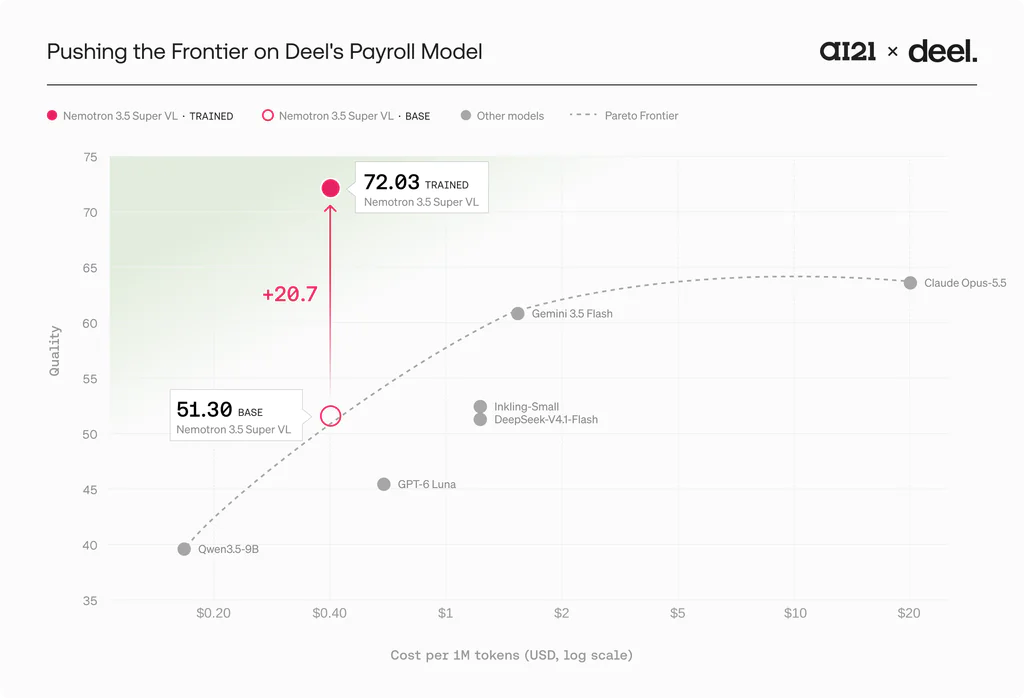
Specialized model #2: Raising accuracy on Deel’s Payroll QA Model to 8% higher than the frontier, while costing 33x less
Post-training objective: Cementing a proprietary edge that frontier models can’t beat
Use case summary
Deel, the global HR and payroll platform, supports more than 40,000 companies across 150+ countries, answering payroll questions that span multiple countries and jurisdictions. What constitutes the right answer depends on local tax rules, employment contracts and company policies – and all three change regularly.
Frontier models know most of these rules individually, yet often leaves part of the answer out. In payroll, though, a partial answer is a wrong answer. Deel wanted an open model that gives the complete answer unprompted, at a fraction of frontier cost.
Methods
For this effort, the AI21 FDR team relied on expert-verified training data and benchmarks from Emet by Deel, a frontier AI evaluation lab that builds benchmarks and expert-generated training data. Building on that foundation, the AI21 FDR team first determined through initial testing that Nemotron 3.5 Super has the required knowledge to answer most of the questions, and could benefit from adapting the model’s behavior to match the level of detail and style expected. In order to bake the desired behavior into the model weights, the FDR team followed a two-step training recipe, beginning with SFT on pruned generated rollouts, followed by SDPO (self distillation policy optimization) in which the teacher gained hindsight by conditioning on detailed instructions on the desired behavior.
Results
As a result of AI21’s post-training efforts on Nemotron 3.5 Super VL, answer accuracy rose to 72% on Emet’s 8-country payroll benchmark evaluation, sitting 8 points above Claude Opus 5.5, and costing 33x less per query.
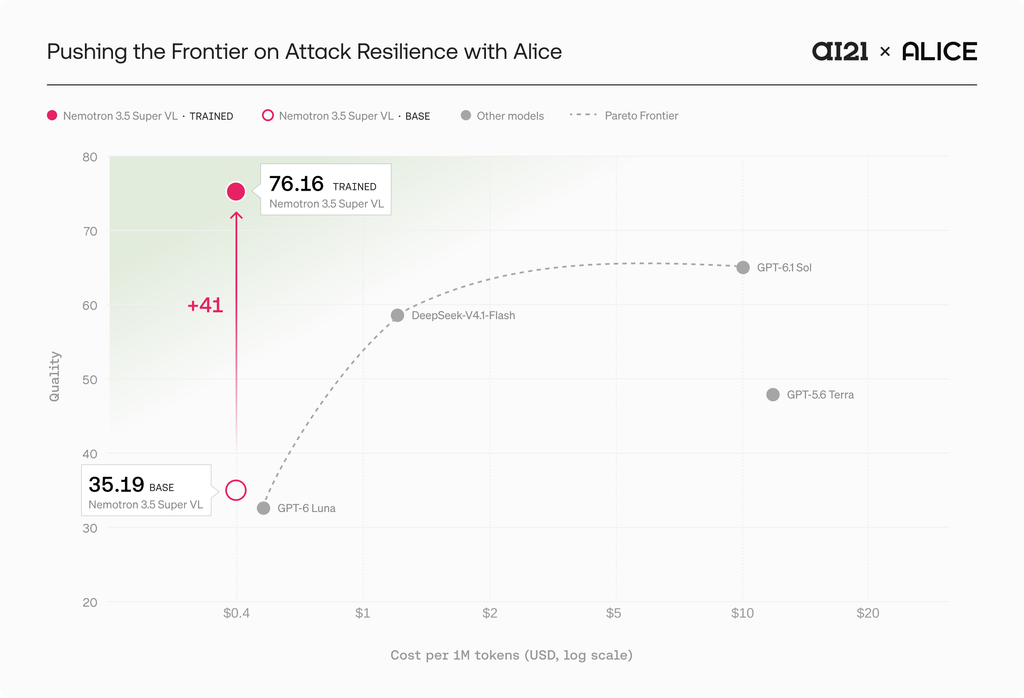
Specialized model #3: Training Nemotron 3.5 Super with Alice’s RL environments to improve attack resilience by 41 points
Post-training objective: Preserving strict control over enterprise data
Use case summary
Alice, an AI safety and security company, builds RL gyms, where customers can train production agents to combat security threats to the real software platforms where they work. RL Environments customers benefit from Alice’s “Rabbit Hole” dataset – sourced from real-world intel on threat actor behavior, as well as input from 150+ staff security researchers and expert network members – and now a post-trained model that is primed to detect indirect prompt injection attacks in both Slack and Github.
Methods
Working closely alongside Alice, our FDR team started by evaluating Nemotron 3.5 Super on their RL gym. In order to improve initial results of the model and increase diversity amongst its answers, the FDR team first applied SFT and DPO training methods. Afterwards, once the trained model had good enough initial performance and diversity, the team brought in GRPO (Online RL) training to further increase the results
Results
Together, AI21 and Alice improved Nemotron 3.5 Super’s attack resilience by 41 points without harming overall task performance, outperforming frontier models like GPT-6.1 Sol. Read more about the collaboration in Alice’s [blog].
Paving the way to AI independence
The three tasks described above cover a wide range of enterprise work, from summarization to knowledge-intensive retrieval to attack resilience. What these tasks do have in common is a repetitive load of up to millions of queries a month and exacting standards of what ‘right’ looks and sounds like, that frontier models can’t always capture.
Post-training Nemotron 3.5 Super on our Harness and Model training platform – directed by our team of FDRs – took all three tasks from the baseline evaluated to specialized intelligence in three weeks, reducing cost and establishing an edge competitors can’t rent and full control over agent behavior.
If you are ready to move forward on the path to AI independence, get in touch.