What are Large Action Models (LAMs)?

When Rabbit’s R1 personal assistant debuted in 2024, it drew attention for one reason: it didn’t just talk — it acted. Behind the device was a Large Action Model (LAM), a new kind of AI able to book rides, send messages, and check flight details without extra prompts.
That launch signaled a turning point. Large Action Models build on the understanding power of Large Language Models (LLMs) but go further — they can take what they understand and use it to perform real tasks. Instead of producing text, they can trigger workflows, issue commands, and make context-aware decisions across digital or physical systems. For enterprises, this shift means AI can now move from generating information to driving automation and outcomes.
The following sections unpack what LAMs are, how they work, and how they differ from LLMs. You’ll also see examples of where they’re already in use, the challenges they bring, and how organizations can start deploying them safely.
What are large action models (LAMs)?
A Large Action Model (LAM) is an artificial intelligence system that can understand instructions and carry them out. It doesn’t stop at giving answers — it takes real steps, such as sending a message, updating a record, or adjusting a process.
While a Large Language Model (LLM) focuses on writing or explaining information, a LAM uses that same understanding to act. It can plan several steps, make simple decisions, and change its approach when conditions shift.
LAMs appear in different forms. Some work fully online, using browsers or APIs to manage emails, schedules, or data. Others combine sight and control, guiding robots or machines through visual input. The most advanced versions handle both language and perception, linking what they see, read, and do in one system.
A LAM’s key feature is its closed loop: it listens, thinks, and acts — giving AI the ability to complete tasks instead of just talking about them.
How do large action models work?
Large Action Models (LAMs) are built in layers, each with a specific role. At the center is a language model that understands meaning and intent. Around it sit modules for planning and decision-making, and connectors that let the model use external tools, databases, or APIs.
This modular setup makes LAMs easier to update and manage. Each layer can improve on its own, and issues are simpler to trace. While all-in-one systems may look simpler, they’re harder to adjust or fix when something goes wrong.
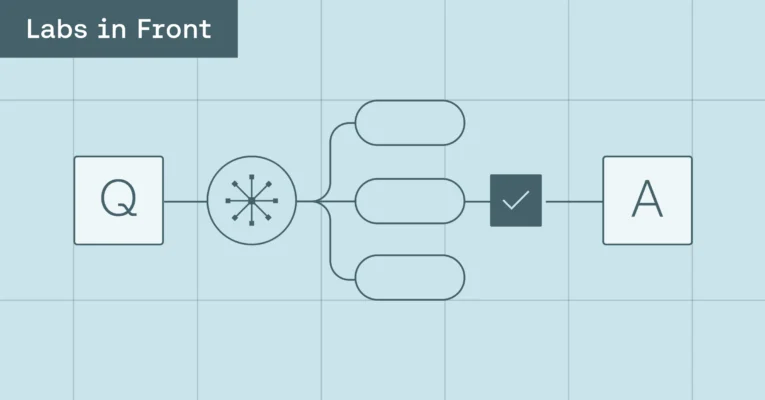
Instead of just replying with text, a LAM follows a repeating loop — it understands, plans, acts, and then learns from what happened.
Step 1: Perception
A LAM starts by understanding what the user wants. It reads or observes input — such as text, images, or on-screen data — and builds a picture of the situation. For instance, it might read a customer message, review past orders, and gather the details it needs to respond.
Step 2: Planning
After it understands the goal, the LAM maps out how to reach it. It breaks the task into smaller steps, checks what depends on what, and decides on an order of actions. For example, in pricing automation, it might check stock levels, compare competitor prices, and decide when to adjust discounts.
Step 3: Execution
Next, the LAM carries out the plan. It can use software tools, run code, send updates, or trigger connected systems — like booking a meeting, sending a report, or changing a machine setting.
Step 4: Adaptation
After acting, the LAM reviews the results. If something doesn’t go as expected, it adjusts its next move. This feedback loop helps it perform better and avoid repeating mistakes.
Step 5: Training
LAMs learn from examples of real tasks, often recorded from human activity across different systems. They’re also fine-tuned using feedback, so they learn which actions work best. Developers sometimes add simulated examples to help the model handle new or rare situations safely.
LAMs vs. LLMs: What are the differences?
Large Action Models (LAMs) and Large Language Models (LLMs) are built on similar technology, but they’re designed to do different things. LLMs focus on understanding and generating text, as well as analyzing information, but can’t act on it by themselves.
LAMs take this a step further. They don’t just understand language; they use that understanding to perform actions automatically. They can plan tasks, make decisions, and interact with other tools or systems without constant human input.
Today, many AI tools sit somewhere in between. These “hybrid” systems utilize LLMs connected to additional software, known as orchestrators, that enable them to perform limited actions, such as sending emails or updating data. While not full LAMs, they show what’s possible when models start to take initiative.
| LLM | LAM | |
| Primary Function | Generate and interpret language. | Understand, reason, and execute multi-step actions. |
| Autonomy | Passive – requires human input to act on results. | Active – can complete end-to-end tasks independently. |
| Adaptation | Limited – responds based on static input context. | Dynamic – continuously adapts to environmental or contextual changes. |
| Tool Invocation | Requires explicit integration or manual prompting for external tools. | Built-in tool use through APIs, function calls, or multi-agent planning. |
| Error Handling | Prone to hallucination or factual errors in language output. | Prone to execution or logic errors during action; requires safety controls. |
| Cost | Lower computational cost; easier to deploy. | Higher infrastructure demands due to planning, context storage, and real-time feedback loops. |
Applications of LAMs in the enterprise
By combining advanced language understanding with the ability to take concrete actions, LAMs are driving automation, enhancing decision-making, and optimizing workflows across various sectors.
Marketing
LAMs can manage campaign personalization at scale. A LAM can track a shopper’s behavior in real-time, so when a user abandons their cart, the LAM automatically updates an email sequence, offers a discount, and adjusts on-site recommendations. The result is improved conversion; however, the limitation lies in ensuring that customer data is handled ethically and transparently to avoid compliance issues.
Customer service optimization
LAMs can act as intelligent service agents. In telecommunications, for example, a LAM could decrease wait times by detecting a connectivity issue, remotely resetting the user’s router, and scheduling a technician if needed, all while notifying the customer.
Sales and lead management
Sales teams can utilize LAMs to automate lead qualification and scheduling. A property team might use a LAM that reads online form submissions, identifies serious buyers, and books viewings based on calendar availability. The model can even adapt follow-up messages depending on a prospect’s tone.
Supply chain efficiency
In retail and logistics, LAMs can forecast demand, place supplier orders, and manage shipment tracking. By comparing supplier pricing and triggering new purchase orders automatically, companies can achieve significant savings.
IT and DevOps Automation
In IT operations, LAMs can detect outages, run diagnostic scripts, and restore services before human engineers are alerted. For example, an LAM could identify server downtime, roll back a faulty update, and log the incident for review.
While the use cases are promising, LAMs rely heavily on accurate data, and errors in inputs can have far-reaching consequences. This level of automation also underscores the need for robust oversight, as incorrect actions can impact real customers in real time. As such, use of LAMs demands strict security controls.
What are the challenges of LAMs?
While the potential of LAMs is immense, their development and deployment also come with significant challenges that need to be addressed.
- Training limitations and cost: LAMs depend on vast datasets of human actions and contextual examples to perform accurately. Collecting this data demands significant computational resources, making development costly and time-intensive.
- Diversity of data: Without enough diversity in training data, LAMs may struggle in unfamiliar environments or replicate human bias.
- Security and compliance risks: Unlike passive models, LAMs can take real actions like sending emails, transferring files, or modifying systems. A Deloitte report found that 55% of organizations avoid certain AI use cases due to concerns around data privacy and security, and it’s important to be clear that LAMs can be subject to misuse or prompt injection attacks, especially when using APIs. To mitigate this, developers should enforce sandboxed environments, strict access controls, and audit trails for all automated actions.
- Integration needs: LAMs often operate within complex ecosystems, so even slight data format changes can cause task failures. As such, regular testing, modular architectures, and fallback mechanisms are essential and must be integrated into AI deployment processes.
- Reliability: LAMs trained on specific workflows may have overfitting to their training environments, failing to generalize to new tasks. In sectors like healthcare or finance, this can lead to unsafe or biased outcomes. As such, human-in-the-loop reviews are required to ensure reliable performance.
- Governance: Enterprises must establish transparent governance frameworks that include explainability tools, audit mechanisms, and clear accountability paths, ensuring LAMs are never allowed to work without checks.
Building and deploying LAMs
Developing and deploying a Large Action Model (LAM) demands careful coordination between model design, environment setup, and governance. Here are the steps to follow.
Dataset and Trajectory Generation
Enterprises should start collecting or generating “action trajectories”, the detailed records of how humans perform tasks across applications. These datasets teach the model how to plan, decide, and execute sequences of actions. Synthetic trajectories are often added to fill gaps or model edge cases safely.
Model Training and Fine-Tuning
Next, the model can be fine-tuned using reinforcement learning, human or AI feedback (RLHF/RLAIF), and task-specific data. This will teach the LAM how to handle multi-step reasoning, adapt to feedback, and optimize its performance over time.
Environment and Tool Integration
LAMs should then be connected to the systems where they’ll operate and given permissions, access controls, and context-grounding rules and boundaries.
Runtime Deployment, Monitoring, and Safety
Once live, enterprises must track latency, error rates, and decision logs to ensure reliability. Thai will require sandboxed environments, fallback modes, and human approval checkpoints.
The road ahead for Large Action Models
Large Action Models (LAMs) are set to accelerate enterprise automation by linking reasoning with real-world execution – a shift often described as agent orchestration. They will manage multi-step workflows that once required human coordination and begin to merge vision and action, allowing
AI to interpret and respond to visual data across dashboards, workflows, and factory floors. Yet their success will depend on trust, safety, and strong governance.
Organizations adopting LAMs should start in controlled environments, measure impact carefully, and keep human oversight in place – balancing the promise of intelligent workflow automation with accountability and control.
FAQs
-
In the coming years, LAMs will change how businesses operate by turning AI from a source of information into a system of action. They can handle repetitive, multi-step processes, such as data entry, monitoring, or workflow execution, freeing employees to focus on strategy and creative work. The biggest gains will come where organizations pair automation with oversight, ensuring that each step LAMs take aligns with company policy, ethics, and customer trust.
-
Agent systems often use existing LLMs paired with orchestrators to perform limited tasks. True LAMs, however, are purpose-built for autonomous execution – they plan, reason, and act within defined environments without relying on human-triggered workflows.
-
LAMs are best introduced once an organization has a mature data infrastructure and clear AI governance frameworks. Early adoption is particularly effective for repetitive, rule-based operations where automation can save significant time or reduce manual errors.
-
Common metrics include task completion rate, execution accuracy, latency, and error recovery efficiency. Enterprises may also track trust and compliance indicators, measuring how safely and reliably a LAM performs within policy limits.
-
Key risks include security breaches, misaligned actions, and data misuse. Organizations should deploy LAMs within sandboxed environments and maintain human-in-the-loop review to catch and correct unintended outcomes.
-
In finance, LAMs automate decision-intensive processes, such as fraud detection, expense review, or portfolio rebalancing. They analyze market data and execute approved actions in real-time, improving speed and accuracy while maintaining compliance through governed oversight.